Refrigerated Trailer for Rent in Awendaw, SC
Get QuoteYou can think of refrigerated trailer rentals almost like a limousine service for your perishable items. In a limo, you get VIP treatment and stylish travel. In an ice truck rental, luxury and style are replaced with plenty of room, accessible storage, and a temperature-controlled environment. These features keep your cargo cool and protected from outdoor elements like rain, sleet, and snow, so you can make sure your items arrive on time when you need them.
You may be wondering to yourself, "Refrigerated trailer rentals sound like the perfect fit for my business. But how do I find them in South Carolina?" The easy answer to that question is to call Charleston Refrigerators Trailers - the Lowcountry's premier choice for high-quality refrigerated trailers and ice truck rentals.
Every one of our refrigerated trailer rentals are:
- Delivered and Set Up for You
- Cleaned and Sanitized After Each Customer
- Pre-Cooled for Your Convenience When Feasible
- Pre-Equipped with Adjustable Temperature Options
- Safe, Secure, and Easy to Use
Service Areas
What Makes Awendaw Refrigerated Trailer Different?
At CRT, we believe that renting a refrigerated trailer is about more than simply having a quality cooling unit. Unlike some refrigerated trailer rental companies, we incorporate friendly, helpful customer service into every transaction we complete. That way, our clients know that they're in good hands every time they call our office and have peace of mind that their business won't suffer due to lack of communication.
We also make it a point to be flexible for our customers and strive to go the extra mile for them to make their jobs and lives easier. Need power cords to hook up your ice truck for rent in Awendaw? No problem, we can make that happen. Need to pick up one of our refrigerated trailer rentals yourself so you can deliver your own goods? We'd be happy to make arrangements so you can do so. Worried about the overnight security of your temperature-sensitive items? We're delighted to provide a padlock for extra security.
When you boil it down to the basics, Awendaw Refrigerated Trailer has become successful in South Carolina because we truly care about our customer's needs and go out of our way to ensure those needs are met.
We offer trailer rentals for both refrigerators and freezers, which are perfect for a number of industries and uses, including the following:
- Catering Companies
- Restaurants
- Festivals
- Family Reunions
- Large Gatherings
- Events
- Parties
- Weddings
- Remote Refrigerated Storage Needs
- Refrigerated Transportation
- Rehearsals
- Emergencies
About Our Refrigerated Trailers for Rent in South Carolina
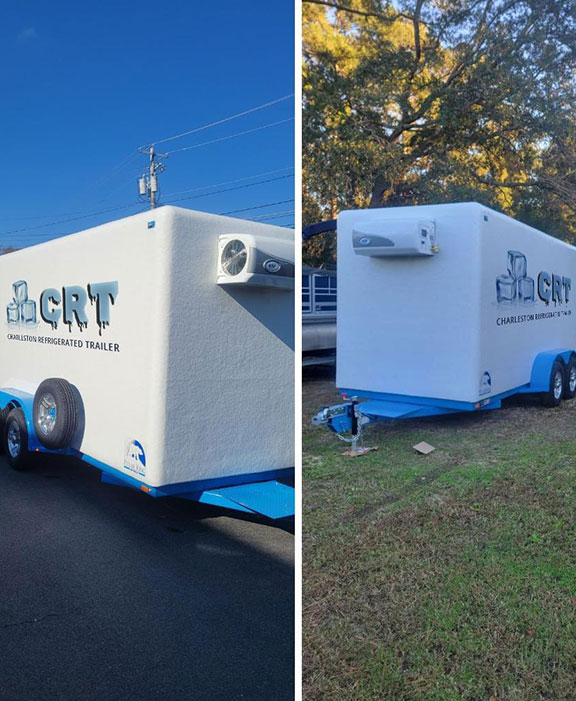
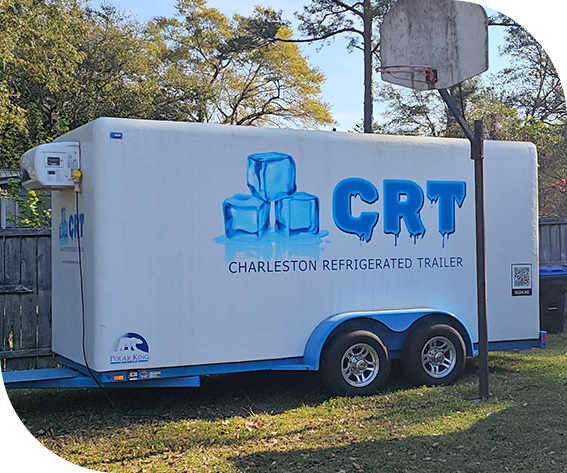
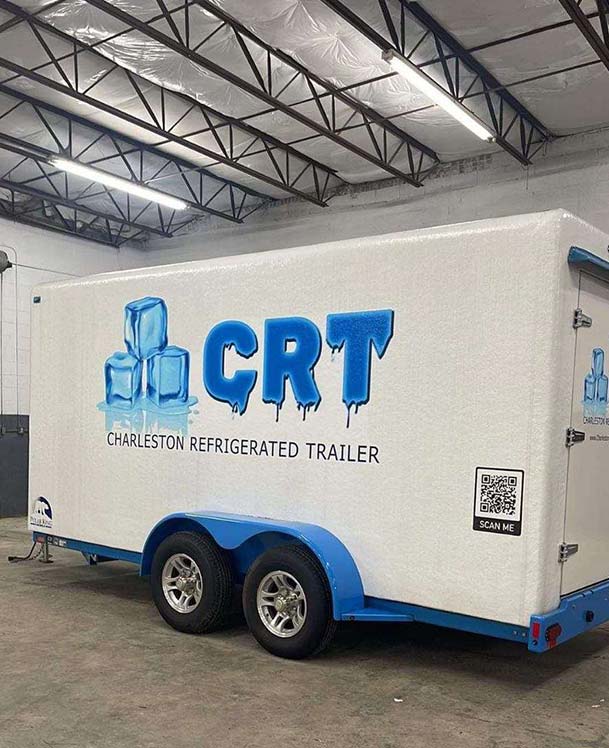
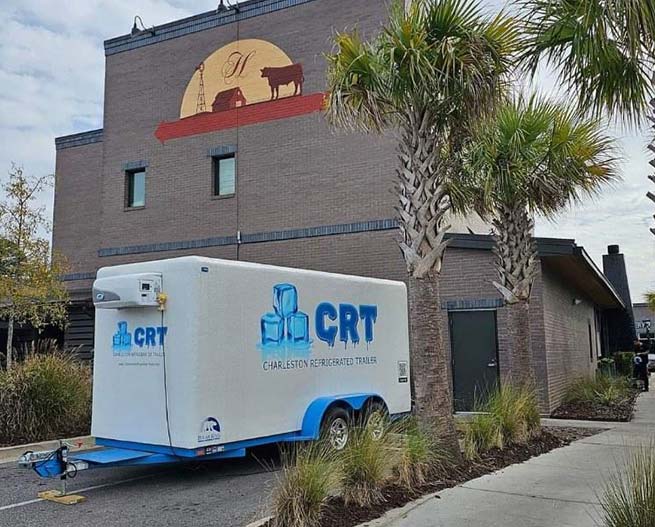
At Charleston Refrigerators Trailers, all of our mobile rentals are well-built and crafted with a seamless fiberglass design for both reliability and refrigeration efficiency. When you make arrangements to have an ice truck for rent in Awendaw delivered or picked up, you'll enjoy a range of helpful trailer features, including the following:
- Each Trailer Comes in a 6x16 Size
- Four-Inch Walls for Structural Rigidity and Cool Air Retention
- 54-Inch Reinforced Doors for Easy Loading and Enhanced Safety
- Pellet-Duty Floor for Ease of Convenience
Cooling and freezing take place reliably with an integrated GOVI Arktik 2000US series refrigeration unit. These compact units provide a temperature range of 0 to 50 degrees F, are all-electric, and only require 110V and 15 amps. Since our coolers have the capability of maintaining temps both below and above 32 degrees Fahrenheit, our ice truck rentals double as both freezers and coolers. This handy feature makes them a more convenient and robust tool for your personal or business needs versus other mobile cooler rentals in Awendaw.
With CRT by your side, there's no need to rent separate ice trucks or mobile refrigerators because our unit is 2-in-1, saving you both time and money.
How Does a Refrigerated Trailer for Rent in Awendaw Work?
Generally speaking, refrigerated trailers aren't meant to cool down or freeze the items stored within them. Instead, they're meant to keep products at a specific temperature for a certain amount of time. At Charleston Refrigerators Trailers, our team members use Polar King Mobile trailers. We made the choice to use this brand for a reason: These ice trucks both meet and exceed all compliance guidelines set forth by the NATM or National Association of Trailer Manufacturers.
Our refrigerated trailers for rent utilize three major components:

Compressor
When the compressor is powered correctly, it draws in refrigerant and then compresses it. Once the refrigerant is compressed, it becomes liquified and is passed along to the trailer's condenser.

Condenser
After the gas is compressed by the compressor, it is passed on to the condenser for a heat exchange process. The condenser fan allows outside air to flow through, leading to the dissipation of heat and a decrease in the refrigerant's temperature. This cooling process results in the refrigerant condensing from hot gas to regular-temperature liquid.

Evaporator
The evaporator receives the liquid refrigerant through an expansion valve that regulates its flow and cooling. The refrigerant transforms into a cool liquid as it passes through the valve, then expands and turns into a warm gas in the evaporator. This gas absorbs the heat and air inside the container and is then drawn into the compressor to restart the cycle.
Awendaw Refrigerated Trailer Pro Tip:
Refrigeration units can run in cycles or continuously. Running the refrigeration unit in cycles reduces fuel consumption but creates more temperature variation. Frozen foods are less sensitive to temperature changes and can endure these variations. Continuous cooling is better suited for products and goods that are not able to withstand temperature variations well. At Charleston Refrigerators Trailers, our mobile rental options utilize continuous cooling to ensure your items don't suffer from temperature variations.
5 Benefits of Using an Ice Truck for Rent in Awendaw
For business owners, managing funds and staying on top of costs is a crucial part of owning a profitable company. Purchasing and maintaining a fleet of refrigerated trailers can be a significant financial burden, requiring substantial capital investment and ongoing maintenance costs. However, renting refrigerated trucks can help businesses allocate their funds more wisely.
That's especially true for businesses that do not frequently engage in long-distance refrigerated shipping. Why purchase an entire vehicle and refrigeration system when you need the trailer for more minor tasks, like delivering flowers on Valentine's Day or storing products after an unexpected power outage? If you have a specific product line or a limited-time special, it's more practical to go with a refrigerated truck for rent than to purchase an ice truck outright.
In terms of the additional benefits of refrigerated trailer rentals, there's no shortage of them to highlight:
- 01 No Maintenance Costs When you rent a refrigerated trailer, one of the biggest benefits is that you don't have to worry about expensive maintenance and repairs. If you were to buy a unit, it would only be a matter of time before you or a qualified professional would have to make repairs. At Awendaw Refrigerated Trailer, all of our trailer rental options are well-maintained and up-to-date on repairs and updates.
- 02 Cost-Effective When you buy an ice truck, you're making a long-term investment that may take a long time to pay off. When you rent, you're getting an immediate solution, which is better for your bank account when you only need the trailer for an abbreviated time.
- 03 No Storage Costs What many folks don't think about when they buy a refrigerated trailer is that they will need someplace to store it when it's not in use. Often, that means paying even more money to rent a storage unit. With a refrigerated trailer for rent in Awendaw, you can eliminate the expenses associated with storage units.
- 04 Focus on Day-to-Day Business Obligations With an ice truck rental, you can concentrate on your core business activities instead of allocating resources towards managing a fleet of trucks and dealing with all the logistics involved.
- 05 Refrigerated Space Catered to Your Needs Renting a refrigerated trailer from CRT means you have the flexibility of booking a short or longer-term trailer rental. That can be very helpful, especially for growing businesses and events that might have changing needs from month to month.
Awendaw Refrigerated Trailer Pro Tip
Looking for a spot to practice towing and trailering? Practicing these maneuvers in an empty parking lot is an excellent idea. It's always better to learn the movements of your trailer in empty spaces, so you can avoid any mishaps like trying to back up and park in front of a busy store.
Get QuoteRefrigerated Trailer FAQs
At Awendaw Refrigerated Trailer, we're big proponents of giving our customers plenty of information. That way, they can make informed purchasing decisions and know how to better operate our ice truck rentals. To keep yourself educated, keep these FAQs in mind:
- Q. Does CRT provide power cords for refrigerated trailer rentals? a. 1 - 100ft Cord Provided.
- Q. What type of plug do I need for towing your trailer? a. You'll need a regular 120v plug within 100 feet of the trailer
- Q. Is it OK to store goods in the trailer rental? a. Yes, absolutely. We'll even provide you with a padlock for extra safety!
- Q. Do I have to clean up when I'm done using the refrigerated trailer rental? a. We ask that at pickup the trailer is in the same condition as when it arrived.
- Q. I need both a freezer and a refrigerated trailer rental. Can you help? a. Our refrigerated trailer rentals are both coolers AND freezers. Depending on your requirements, we can regulate the temperature from 0 to 50 degrees F.
The Top Choice for Refrigerated Trailer Rentals in South Carolina
Renting a refrigerated trailer just makes good sense for many businesses in Awendaw and the metro area. That's why Awendaw Refrigerated Trailer proudly serves South Carolina and the Lowcountry with refrigerated and frozen transportation rentals. If you're looking for the reliability, convenience, flexibility, and cost-effectiveness of a refrigerated trailer for rent in Awendaw, look no further than CRT.
 (843) 296-6617
Request a Quote
Latest News in Awendaw, SC
A History of Awendaw’s First Residents
Rachael Lolar Special to The Post and Courierhttps://www.postandcourier.com/a-history-of-awendaw-s-first-residents/article_d39ba248-6dc5-11ee-adf5-cbf67704a486.html
Charleston is a region steeped in history, and every corner has its own story that contributes a piece of the Lowcountry’s historical tapestry.The Town of Awendaw, located along U.S. Highway 17 N between Mount Pleasant and McClellanville in Charleston County, has Native American roots through the Sewee tribe.The Sewee tribe lived along the lower part of the Santee River, along the coast to the westward divide of the Ashley River, in present-day Moncks Corner and Dewees Island. Sewee, which means “Islanders,” w...
Charleston is a region steeped in history, and every corner has its own story that contributes a piece of the Lowcountry’s historical tapestry.
The Town of Awendaw, located along U.S. Highway 17 N between Mount Pleasant and McClellanville in Charleston County, has Native American roots through the Sewee tribe.
The Sewee tribe lived along the lower part of the Santee River, along the coast to the westward divide of the Ashley River, in present-day Moncks Corner and Dewees Island. Sewee, which means “Islanders,” were one of more than two dozen Native American tribes that occupied the South Carolina coast long before European settlers stepped foot on the coastal soil.
In 1696, settlers who retreated from Salem, Massachusetts, after the Salem Witch Trials founded “Wappetaw,” which is now known as Awendaw.
Like most Native American tribes, the Sewee people were impacted by diseases and warfare. However, their mark on the land still stands today in the form of a shell mound.
The Awendaw Sewee Shell Mound is one of the oldest and northernmost mounds found along the Carolina coast and is comprised mainly of oyster shells. Similar Native American shell rings can also be found in Mount Pleasant and Hilton Head Island. According to archeologists, the Sewee mound is believed to be roughly 4,000 years old. While it is generally thought that the mound was a dumping ground for old oyster shells, there are theories that the shell rings served a ceremonial purpose.
The Sewee Shell Ring is located near a preserved freshwater marsh, and the site can be seen from a new trail in the Francis Marion National Forest that reopened in 2022, replacing the wooden boardwalk with a fiberglass structure that is designed to last longer and withstand storms. The one-mile self-guided trail features five interpretive stops and views of wildflowers, salt marsh and tidal creeks. It’s a perfect way to immerse yourself in the beauty of the Lowcountry and experience the land where the Sewee once lived.
While little information remains about the daily lives of the Sewee people, local historians and the Town of Awendaw have made an effort to research and remember these Native Americans who lived, hunted and fished in this area. The Sewee name can be found at various establishments throughout Awendaw, such as the Sewee Outpost store, the See Wee Restaurant, the Sewee Visitor and Environmental Education Center.
Whether you’re just visiting the area or taking up permanent residence in Awendaw, be sure to plan a trip to the Francis Marion National Forest and allow yourself to walk in the woods, be surrounded by the unspoiled beauty of the Lowcountry, and visit the historic shell ring to pay tribute to Awendaw’s first residents.
Major land expansion coming to Cape Romain National Wildlife Refuge in Awendaw
Melissa Rademakerhttps://www.live5news.com/2023/10/10/major-land-expansion-coming-cape-romain-national-wildlife-refuge-awendaw/
CHARLESTON COUNTY, S.C. (WCSC) - A $5 million federal investment will soon add 446 acres of land along the South Carolina shoreline.Cape Romain National Wildlife Refuge is currently made up of 22 miles of barrier islands. Sarah Dawsey, the refuge manager, has been working with nature preservation since she was in high school and joined the Youth Conservation Corps.“This has been a lifelong goal for me. I mean, I can’t tell you how ecstatic I am to get this money. We have barrier islands, the refuge is barrier island...
CHARLESTON COUNTY, S.C. (WCSC) - A $5 million federal investment will soon add 446 acres of land along the South Carolina shoreline.
Cape Romain National Wildlife Refuge is currently made up of 22 miles of barrier islands. Sarah Dawsey, the refuge manager, has been working with nature preservation since she was in high school and joined the Youth Conservation Corps.
“This has been a lifelong goal for me. I mean, I can’t tell you how ecstatic I am to get this money. We have barrier islands, the refuge is barrier islands, and they’re only accessible by boat,” Dawsey says.
Coastal Expeditions does run a ferry to Bulls Island for a fee so those interested can visit for the day. There is a public dock on the island for those with boats to use as well.
“This money will allow us to have a tract on the mainland, where we can have trails, we can have hunting, fishing, environmental education, everything that we do on the islands, but to a greater extent and you don’t have to have a boat so it’s really exciting,” Dawsey says.
She also notes that a mainland tract is a step toward a future corridor connecting the refuge to the Francis Marion National Forest.
Durwin Carter is the project leader for Cape Romain, Ace Basin, Santee and Waccamaw National Wildlife Refuges. He says any addition of land is a huge win for conservation efforts, wildlife and the people nearby who can enjoy it.
“It ties directly into what our mission is. Our mission is essentially working with other partners to conserve these lands and habitats and the critters that use it, for the public to enjoy,” Carter says.
Dawsey and Carter pointed out how erosion from storms and sea level rise are threatening the barrier islands and, in their time at the refuge, they have seen the saltwater breach into ponds on Bulls Island and encroach further into the land each year.
“With the threats happening with development and habitat fragmentation and sea level rise, any additional lands that we can conserve are going to be beneficial. We do what we do for the wildlife, for the habitats and for people to enjoy. But we also do it for future generations to enjoy,” Carter says.
The funding comes from the Migratory Bird Conservation Fund. The fund is made up from the sale of Federal Migratory Bird Hunting and Conservation Stamps, commonly known as Duck Stamps, and import taxes.
The refuge has a visitors center located off Highway 17 where people can learn more about the conservation work and migratory bird protection the islands offer. Dawsey says people are always welcome to visit Bulls Island as long as they come with respect for the wildlife and leave it as they found it.
“If you see birds flying around or acting unusual or dive bombing you, that’s a signal that you’re close to their nest and they’re just trying to protect their babies,” Dawsey says.
Cape Romain is home to more than 290 bird species that migrate through the area as well as other animals like alligators, deer and sea turtles.
“We are just winding up our field season, so we have a really big loggerhead sea turtle project, it’s seven days a week. We do a lot of posting for birds and stewarding to keep people out of the bird areas and educating people on why it’s important,” Dawsey says.
Carter says his staff and volunteers are grateful for the land the refuge currently gets to take care of. They are looking forward to the expansion once the sale is finalized and eventually to hosting wildlife and visitors on the new mainland tracts.
“We’re really lucky to have the jobs that we have because they really enjoy their time out on the water of Cape Romain; really enjoy their times out on the trails, enjoy their times out appreciating the refuge, doing birdwatching, fishing, hunting, whatever it is, we’re constantly reminded of how great our jobs are because we get a chance to see this every day,” Carter says.
Copyright 2023 WCSC. All rights reserved.
Editorial: Awendaw must rise to challenge of new development
THE EDITORIAL STAFFhttps://www.postandcourier.com/opinion/editorials/editorial-awendaw-must-rise-to-challenge-of-new-development/article_ff5c8c82-cf17-11ed-874d-dfb9ed8cbe1a.html
The town of Awendaw was incorporated more than three decades ago, not so much to provide municipal services but to let residents control their planning and zoning decisions rather than relying on county government. In recent years, however, that job has become increasingly challenging because Mount Pleasant is running out of large developable sites, our region's continued growth is creating dramatic demand for more housing and Awendaw's location helps it retain much of its rural charm, wedged as it is between two environmental treasures of n...
The town of Awendaw was incorporated more than three decades ago, not so much to provide municipal services but to let residents control their planning and zoning decisions rather than relying on county government. In recent years, however, that job has become increasingly challenging because Mount Pleasant is running out of large developable sites, our region's continued growth is creating dramatic demand for more housing and Awendaw's location helps it retain much of its rural charm, wedged as it is between two environmental treasures of national significance: the Cape Romain National Wildlife Refuge and the Francis Marion National Forest.
It's more important than ever that town officials recognize the growing importance and intensity of their planning work — and rise to the occasion to protect the relaxed, rural ambiance that has defined this part of South Carolina's coast.
There are some encouraging signs.
A year ago, we lamented proposals to develop two large subdivisions, with 249 and 204 homes respectively, to be served by individual septic tanks since there are no sewer lines in the town. Those are still in the permitting stages and we hope they will be scaled back if they're built at all. They certainly underscore the need for state regulators to consider the cumulative impact of large subdivisions with dozens, even hundreds, of septic tanks that can compromise nearby waterways, as they have done along Shem and James Island creeks.
But the encouraging news is when yet another septic-tank subdivision was proposed recently, the Awendaw Planning Commission voted unanimously against Sewee Landing's 72 homes on 50 acres. At the same meeting, the commission recommended an update of the town's planned development ordinance that these subdivisions had relied on.
Awendaw Town Council could consider both the subdivision proposal and the ordinance rewrite as early as this week, and we urge council members to follow their planning commissioners' advice.
Even when a septic system is well-maintained, it can face problems if the water table is too high, and rising groundwater can carry the resulting contaminants to rivers and marshes, a problem that's expected to grow more acute as climate change pushes sea levels higher. Awendaw's proximity to the pristine Cape Romain makes it a desirable place to live, but too many septic tanks too close to the refuge (and too close to each other) could taint the very thing that makes the area an attractive place to visit and to live.
These developments don't pose a threat simply because they would rely on septic systems. They also would increase the amount of impervious surface and stormwater runoff, exacerbate habitat loss and degrade the community's rural character.
Awendaw is a small town that seems to have been pushed around at times. Its deal for a new park to be created by then-Charleston County Councilman Elliott Summey in exchange for Mr. Summey's right to mine dirt on the park site ended badly. The mining stopped in 2019, but the town had to sue to try to get an accounting of what was done there; the park itself is still a distant dream. In another part of town, the King Tract mine was allowed to expand even though it had been hit with more than a dozen water quality violations.
So we're encouraged that there's a proactive solution in the works. Awendaw is drafting a new comprehensive plan to replace one that's 13 years old. This process will provide town leaders, residents and others a perfect chance to forge a shared vision of how the town should manage growth, and they should make sure they make the most of this chance.
After all, the pressures on their town are only expected to intensify in the years to come.
Click here for more opinion content from The Post and Courier.
Get a weekly recap of South Carolina opinion and analysis from The Post and Courier in your inbox on Monday evenings.
Proposed development in Awendaw causing controversy
Katie Augustinehttps://www.counton2.com/top-stories/proposed-development-in-awendaw-causing-controversy/
AWENDAW, S.C. (WCBD) -A proposed development, the White Tract Development, in Awendaw has some neighbors calling for a time-out.Pulte Homes, one of the nation’s largest homebuilders, is seeking the Town of Awendaw’s approval to build a 200+ home subdivision on approximately 148 acres. The planned location is just down the street from the intersection of Seewee and Bulls Island Roads.Some neighbors say they’re worried a large subdivision could cause future problems for the area.“If you go down Bull...
AWENDAW, S.C. (WCBD) -A proposed development, the White Tract Development, in Awendaw has some neighbors calling for a time-out.
Pulte Homes, one of the nation’s largest homebuilders, is seeking the Town of Awendaw’s approval to build a 200+ home subdivision on approximately 148 acres. The planned location is just down the street from the intersection of Seewee and Bulls Island Roads.
Some neighbors say they’re worried a large subdivision could cause future problems for the area.
“If you go down Bulls Island Road right now, it’s very peaceful and tranquil…a pretty little country scene.,” said Greg St. Pierre, an Awendaw resident. “They’re gonna exploit every bit of that.”
St. Pierre and his neighbors understand growth is inevitable, but they’re hopeful Awendaw leaders will do it in what they call “the right way.” St. Pierre says there should be proactive plans for stormwater drainage, traffic mitigation, improved roadways, and more before the neighborhood is built. Additionally, the proposed spot is close to a National Wildlife Refuge and neighbors say it could be harmful to the species that thrive there.
On top of that, he says residents weren’t informed about the possible development until very recently and are now being asked to voice their opinions in a public hearing next week.
“Basically, the people are just asking for a little bit more time to understand what’s happening here.”
“You can’t stop people from selling their land, you can’t stop development from happening. It’s gonna happen, but do the right thing and don’t cram a bunch of cookie-cutter houses on postage-stamp-sized lots,” said St. Pierre.
Another concern by St. Pierre is the town’s lack of a full-time planning director. Currently, the town only has a part-time interim planning director in-house four hours per week.
News 2 contacted the Town of Awendaw with some of the questions posed by St. Pierre. The questions and answers are below.
Q: Are you aware of the concerns of Awendaw residents about the potential White Tract development? If so, what is your response?
A: The Town is aware of the concerns about the White Tract development. The White Tract Development is being developed under the auspices of a Planned Development adopted by Town Council in 2006. The approval of that Planned Development document also raised many of the concerns the Town is hearing today. A Planned Development is utilized in order to allow the Town to allow flexibility in development that will result in improved design, character, and quality of new developments and preserve natural and scenic features of open spaces. The Town of Awendaw provides for the establishment of planned development districts as amendments to a locally adopted zoning ordinance and official zoning map. The adopted Planned Development map is the zoning district map for the property. The planned development provisions must encourage innovative site planning within planned development districts. Planned development districts may provide for variations from other ordinances and the regulations of other established zoning districts concerning use, setbacks, lot size, density, bulk, and other requirements to accommodate flexibility in the arrangement of uses for the general purpose of promoting and protecting the public health, safety, and general welfare.
Q: We are hearing concerns about infrastructure surrounding the area (roads, water drainage, etc.) should a subdivision be built in the listed area. Does the town have proactive plans to address possible future problems (deteriorating roads, a lack of turning lanes leading to traffic safety concerns, water drainage) as a result of a large neighborhood?
In collaboration with the County of Charleston, the Army Corps of Engineers, DHEC and other jurisdictions, the Town is assured that roadways, stormwater drainage and traffic concerns are addressed. The Town may request additional plans and specifications of the developer of the land should they feel that something might need to mitigated in an appropriate fashion. The applicant has submitted plans to subdivide the three parcels of approximate 148 acres in to 204 parcels.
Q: I understand the Town of Awendaw only has a part-time (4 hours per week) Planning Director. Can the town handle a development of this size?
A: This is correct. The BCDCOG is contracting with the Town to provide an experienced Planning Director on an Interim basis. The Director is on-site at Town Hall for 4 hours per week, however, the Director spends upwards of 10-16 hours per week on Awendaw business. The past Town Administrator, Bill Wallace, is also actively working part-time for the Town and has over 4 decades of urban planning experience. Between the two individuals, the Town feels we have more than adequate experience to handle this project.
“If we can’t stop the neighborhood, we’re going to try to push for more green spaces, road improvements, anything that’s gonna help in the community,” said St. Pierre.
A public hearing is set for March 21st at 6 p.m. at Awendaw Town Hall for residents to share their opinions on the proposed development. St. Pierre says many people plan to come out and voice their concerns in hopes that the application for development will be denied.
New Awendaw middle and high school could be partially magnet
Anna Harrishttps://www.live5news.com/2022/09/22/new-awendaw-middle-high-school-could-be-partially-magnet/
AWENDAW, S.C. (WCSC) - A potential new middle and high school in Awendaw has a chance to be a partial magnet school, and students from multiple parts of the district can be pulled to take part in a specialized curriculum.Charleston County School District Board Members and the people of Mount Pleasant got to hear new details about the potential schools on Wednesday. District officials told people at the meeting, held at Laing Middle School, that a lot of the plans right now are just ideas with no specific timeline.This new middl...
AWENDAW, S.C. (WCSC) - A potential new middle and high school in Awendaw has a chance to be a partial magnet school, and students from multiple parts of the district can be pulled to take part in a specialized curriculum.
Charleston County School District Board Members and the people of Mount Pleasant got to hear new details about the potential schools on Wednesday. District officials told people at the meeting, held at Laing Middle School, that a lot of the plans right now are just ideas with no specific timeline.
This new middle and high school would be located on 107 acres at Highway 17 and Jenkins Hill Road. As part of this plan, district staff presented concept maps with multiple options for rezoning.
Jeff Borowy, the Chief Operating Officer for the district, says this plan will be a challenge.
“Most of the times we build a school, we just build a specific zone of attendance for that school, but in this case, we want to have a number of students to offer the right programs for those students,” Borowy said. “So, we have to look out of the box and look for something different beyond the zone.”
District staff says one of the main challenges is making sure that each school holds a maximum of 500 students. This would pull in kids from D1, the Awendaw-McClellanville area, and some from D2 in the northern Mount Pleasant area.
Staff also say they are continuing to research desirable education options for a partial magnet school to reach that target enrollment.
“It’s going to be very important to let’s build the school from up, but at the same time, let’s figure out what we’re going to be doing inside,” Thomas Colleton, D1 Constituent Board Chair, said. “The curriculum needs a lot.”
There is currently no timeline on construction for the schools because the district does not know if this magnet option will be included. The district says it is possible that the earliest we can start to see construction would be in four years.
Jonathan Mars, a parent of two children at Carolina Park Elementary, says this could be an option for his family when his kids get older.
“But it does sound like they’re going to have very specific programs at the school,” Mars said. “So, for example, if there’s a great art program and my daughter’s really into art that seems like a great option to have.”
As of now, this project is not fully funded and the district says they do not have a price estimate.
They say the next step is to charter a blue-ribbon committee in mid-October that will look at enrollment numbers and look at the best options to make this project successful.
Copyright 2022 WCSC. All rights reserved.
Disclaimer: