Refrigerated Trailer for Rent in North Charleston, SC
Get QuoteYou can think of refrigerated trailer rentals almost like a limousine service for your perishable items. In a limo, you get VIP treatment and stylish travel. In an ice truck rental, luxury and style are replaced with plenty of room, accessible storage, and a temperature-controlled environment. These features keep your cargo cool and protected from outdoor elements like rain, sleet, and snow, so you can make sure your items arrive on time when you need them.
You may be wondering to yourself, "Refrigerated trailer rentals sound like the perfect fit for my business. But how do I find them in South Carolina?" The easy answer to that question is to call Charleston Refrigerators Trailers - the Lowcountry's premier choice for high-quality refrigerated trailers and ice truck rentals.
Every one of our refrigerated trailer rentals are:
- Delivered and Set Up for You
- Cleaned and Sanitized After Each Customer
- Pre-Cooled for Your Convenience When Feasible
- Pre-Equipped with Adjustable Temperature Options
- Safe, Secure, and Easy to Use
Service Areas
What Makes North Charleston Refrigerated Trailer Different?
At CRT, we believe that renting a refrigerated trailer is about more than simply having a quality cooling unit. Unlike some refrigerated trailer rental companies, we incorporate friendly, helpful customer service into every transaction we complete. That way, our clients know that they're in good hands every time they call our office and have peace of mind that their business won't suffer due to lack of communication.
We also make it a point to be flexible for our customers and strive to go the extra mile for them to make their jobs and lives easier. Need power cords to hook up your ice truck for rent in North Charleston? No problem, we can make that happen. Need to pick up one of our refrigerated trailer rentals yourself so you can deliver your own goods? We'd be happy to make arrangements so you can do so. Worried about the overnight security of your temperature-sensitive items? We're delighted to provide a padlock for extra security.
When you boil it down to the basics, North Charleston Refrigerated Trailer has become successful in South Carolina because we truly care about our customer's needs and go out of our way to ensure those needs are met.
We offer trailer rentals for both refrigerators and freezers, which are perfect for a number of industries and uses, including the following:
- Catering Companies
- Restaurants
- Festivals
- Family Reunions
- Large Gatherings
- Events
- Parties
- Weddings
- Remote Refrigerated Storage Needs
- Refrigerated Transportation
- Rehearsals
- Emergencies
About Our Refrigerated Trailers for Rent in South Carolina
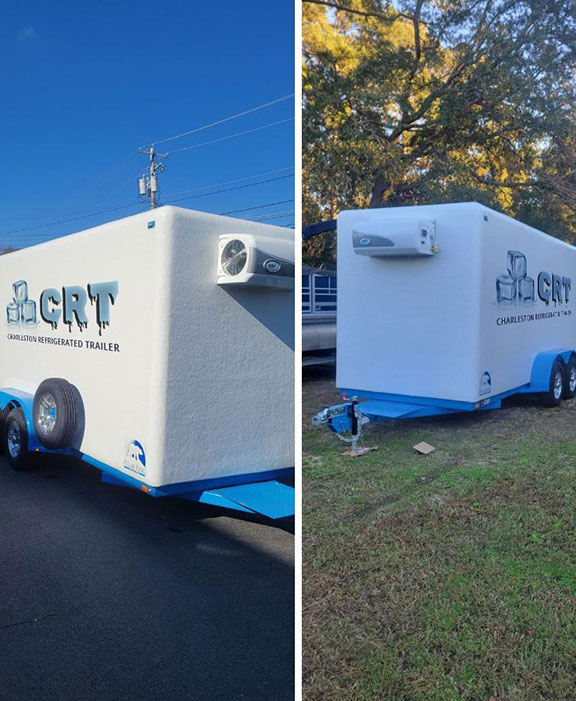
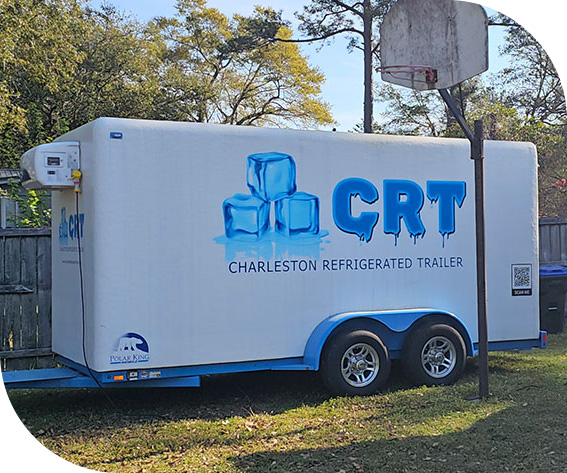
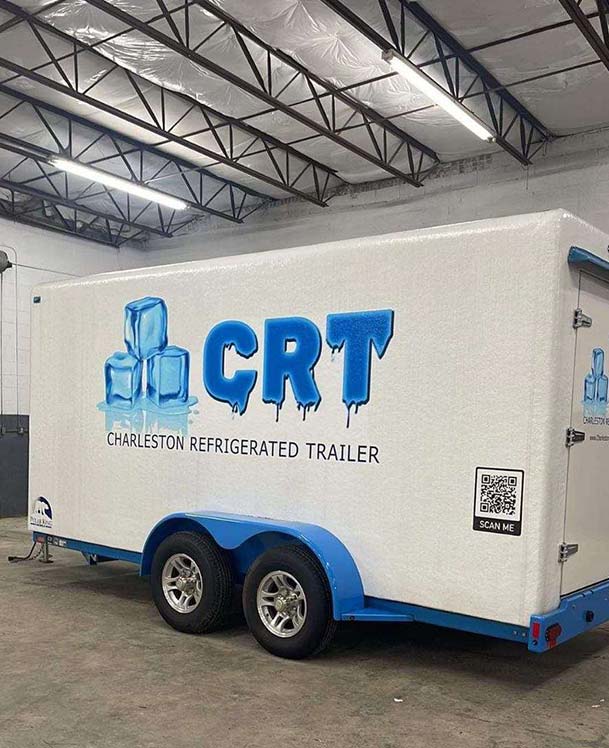
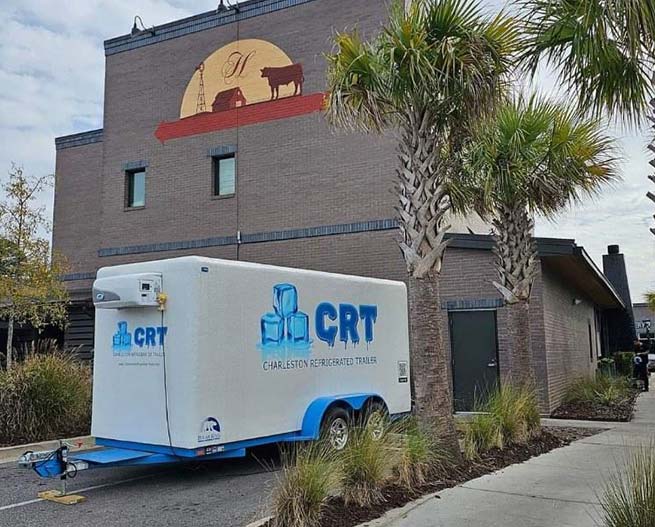
At Charleston Refrigerators Trailers, all of our mobile rentals are well-built and crafted with a seamless fiberglass design for both reliability and refrigeration efficiency. When you make arrangements to have an ice truck for rent in North Charleston delivered or picked up, you'll enjoy a range of helpful trailer features, including the following:
- Each Trailer Comes in a 6x16 Size
- Four-Inch Walls for Structural Rigidity and Cool Air Retention
- 54-Inch Reinforced Doors for Easy Loading and Enhanced Safety
- Pellet-Duty Floor for Ease of Convenience
Cooling and freezing take place reliably with an integrated GOVI Arktik 2000US series refrigeration unit. These compact units provide a temperature range of 0 to 50 degrees F, are all-electric, and only require 110V and 15 amps. Since our coolers have the capability of maintaining temps both below and above 32 degrees Fahrenheit, our ice truck rentals double as both freezers and coolers. This handy feature makes them a more convenient and robust tool for your personal or business needs versus other mobile cooler rentals in North Charleston.
With CRT by your side, there's no need to rent separate ice trucks or mobile refrigerators because our unit is 2-in-1, saving you both time and money.
How Does a Refrigerated Trailer for Rent in North Charleston Work?
Generally speaking, refrigerated trailers aren't meant to cool down or freeze the items stored within them. Instead, they're meant to keep products at a specific temperature for a certain amount of time. At Charleston Refrigerators Trailers, our team members use Polar King Mobile trailers. We made the choice to use this brand for a reason: These ice trucks both meet and exceed all compliance guidelines set forth by the NATM or National Association of Trailer Manufacturers.
Our refrigerated trailers for rent utilize three major components:

Compressor
When the compressor is powered correctly, it draws in refrigerant and then compresses it. Once the refrigerant is compressed, it becomes liquified and is passed along to the trailer's condenser.

Condenser
After the gas is compressed by the compressor, it is passed on to the condenser for a heat exchange process. The condenser fan allows outside air to flow through, leading to the dissipation of heat and a decrease in the refrigerant's temperature. This cooling process results in the refrigerant condensing from hot gas to regular-temperature liquid.

Evaporator
The evaporator receives the liquid refrigerant through an expansion valve that regulates its flow and cooling. The refrigerant transforms into a cool liquid as it passes through the valve, then expands and turns into a warm gas in the evaporator. This gas absorbs the heat and air inside the container and is then drawn into the compressor to restart the cycle.
North Charleston Refrigerated Trailer Pro Tip:
Refrigeration units can run in cycles or continuously. Running the refrigeration unit in cycles reduces fuel consumption but creates more temperature variation. Frozen foods are less sensitive to temperature changes and can endure these variations. Continuous cooling is better suited for products and goods that are not able to withstand temperature variations well. At Charleston Refrigerators Trailers, our mobile rental options utilize continuous cooling to ensure your items don't suffer from temperature variations.
5 Benefits of Using an Ice Truck for Rent in North Charleston
For business owners, managing funds and staying on top of costs is a crucial part of owning a profitable company. Purchasing and maintaining a fleet of refrigerated trailers can be a significant financial burden, requiring substantial capital investment and ongoing maintenance costs. However, renting refrigerated trucks can help businesses allocate their funds more wisely.
That's especially true for businesses that do not frequently engage in long-distance refrigerated shipping. Why purchase an entire vehicle and refrigeration system when you need the trailer for more minor tasks, like delivering flowers on Valentine's Day or storing products after an unexpected power outage? If you have a specific product line or a limited-time special, it's more practical to go with a refrigerated truck for rent than to purchase an ice truck outright.
In terms of the additional benefits of refrigerated trailer rentals, there's no shortage of them to highlight:
- 01 No Maintenance Costs When you rent a refrigerated trailer, one of the biggest benefits is that you don't have to worry about expensive maintenance and repairs. If you were to buy a unit, it would only be a matter of time before you or a qualified professional would have to make repairs. At North Charleston Refrigerated Trailer, all of our trailer rental options are well-maintained and up-to-date on repairs and updates.
- 02 Cost-Effective When you buy an ice truck, you're making a long-term investment that may take a long time to pay off. When you rent, you're getting an immediate solution, which is better for your bank account when you only need the trailer for an abbreviated time.
- 03 No Storage Costs What many folks don't think about when they buy a refrigerated trailer is that they will need someplace to store it when it's not in use. Often, that means paying even more money to rent a storage unit. With a refrigerated trailer for rent in North Charleston, you can eliminate the expenses associated with storage units.
- 04 Focus on Day-to-Day Business Obligations With an ice truck rental, you can concentrate on your core business activities instead of allocating resources towards managing a fleet of trucks and dealing with all the logistics involved.
- 05 Refrigerated Space Catered to Your Needs Renting a refrigerated trailer from CRT means you have the flexibility of booking a short or longer-term trailer rental. That can be very helpful, especially for growing businesses and events that might have changing needs from month to month.
North Charleston Refrigerated Trailer Pro Tip
Looking for a spot to practice towing and trailering? Practicing these maneuvers in an empty parking lot is an excellent idea. It's always better to learn the movements of your trailer in empty spaces, so you can avoid any mishaps like trying to back up and park in front of a busy store.
Get QuoteRefrigerated Trailer FAQs
At North Charleston Refrigerated Trailer, we're big proponents of giving our customers plenty of information. That way, they can make informed purchasing decisions and know how to better operate our ice truck rentals. To keep yourself educated, keep these FAQs in mind:
- Q. Does CRT provide power cords for refrigerated trailer rentals? a. 1 - 100ft Cord Provided.
- Q. What type of plug do I need for towing your trailer? a. You'll need a regular 120v plug within 100 feet of the trailer
- Q. Is it OK to store goods in the trailer rental? a. Yes, absolutely. We'll even provide you with a padlock for extra safety!
- Q. Do I have to clean up when I'm done using the refrigerated trailer rental? a. We ask that at pickup the trailer is in the same condition as when it arrived.
- Q. I need both a freezer and a refrigerated trailer rental. Can you help? a. Our refrigerated trailer rentals are both coolers AND freezers. Depending on your requirements, we can regulate the temperature from 0 to 50 degrees F.
The Top Choice for Refrigerated Trailer Rentals in South Carolina
Renting a refrigerated trailer just makes good sense for many businesses in North Charleston and the metro area. That's why North Charleston Refrigerated Trailer proudly serves South Carolina and the Lowcountry with refrigerated and frozen transportation rentals. If you're looking for the reliability, convenience, flexibility, and cost-effectiveness of a refrigerated trailer for rent in North Charleston, look no further than CRT.
 (843) 296-6617
Request a Quote
Latest News in North Charleston, SC
Editorial: SC port expansion is needed, but keep North Charleston’s needs in mind
THE EDITORIAL STAFFhttps://www.postandcourier.com/opinion/editorials/sc-gov-henry-mcmaster-wants-land-for-new-terminal/article_584e3a44-afef-11ee-9acc-ff471978a058.html
South Carolina’s ports lost a decade’s worth of momentum in their unsuccessful attempt to expand container terminal operations onto the southern end of Daniel Island two decades ago.The Global Gateway project consumed several years of planning and efforts that turned out to be in vain, as opposition to the expansion ultimately scuttled it and led the port instead to expand its operations on the southern end of the former Charleston Naval Base, an expansion now known as the Hugh Leatherman Terminal.That’s why w...
South Carolina’s ports lost a decade’s worth of momentum in their unsuccessful attempt to expand container terminal operations onto the southern end of Daniel Island two decades ago.
The Global Gateway project consumed several years of planning and efforts that turned out to be in vain, as opposition to the expansion ultimately scuttled it and led the port instead to expand its operations on the southern end of the former Charleston Naval Base, an expansion now known as the Hugh Leatherman Terminal.
That’s why we support Gov. Henry McMaster’s request that lawmakers provide $55 million to purchase a now-shuttered WestRock paper mill on the Cooper River, just next door to the North Charleston terminal. It’s not every day the state has a chance to buy from a willing seller a significant chunk of industrial waterfront property near its major port operation; those chances should be seized when they appear. It certainly will put the port in a better position to expand in the long run.
As we noted after Ports Authority CEO Barbara Melvin’s most recent State of the Port address, it’s not too early for the port to begin planning for what it will do once its two major container terminals — the Wando Welch in Mount Pleasant and the new Hugh Leatherman in North Charleston — fill up. The North Charleston Terminal is a much smaller operation but already plays a key role, and the Ports Authority is looking at upgrades that eventually could allow it to handle about 2.4 million containers of cargo — the same volume as the Wando Welch, now its busiest terminal.
One upgrade already is in the works, as the S.C. Department of Transportation is planning to rebuild the adjacent portion of Interstate 526, a project that would include replacing the existing 160-foot-tall Don Holt Bridge with a taller span that would enable larger container ships to pass underneath. The other upgrade — the expansion of the terminal site through the acquisition of the WestRock property — could fall into place this year, provided that lawmakers agree to Mr. McMaster’s request and approve the money. They should. The time is right.
It might seem premature to work on readying the North Charleston Terminal for more business when the Leatherman terminal is still several years from being built out, much less fully occupied, but as we have seen, it is taking an increasingly long time to plan, permit and construct major public works projects, even when the political will and public money are all lined up.
And as plans for upgrading the North Charleston Terminal proceed, we urge Ms. Melvin and the Ports Authority to show similar sensitivity to any concerns from the city and nearby neighbors. The WestRock mill contributed almost $1 million to the city’s coffers, for instance, and expanding this terminal’s operations would have significant impacts on traffic, railroad activity and noise — all of which should be taken seriously and, when possible, lessened or mitigated.
There is a lot of upside to making this land purchase that eventually would help turn the North Charleston Terminal into a larger, more vital operation, particularly given its proximity to a rail line and major highways — and the availability of industrial land next door — and it’s not too early to feel a sense of urgency. As we’ve noted before, our region and our state will be poorer if the Ports Authority’s next big expansion is as bumpy as the one that led to the Leatherman Terminal. The state’s purchase of the paper mill will mark a significant step to ensure it isn’t.
Click here for more opinion content from The Post and Courier.
Get a weekly recap of South Carolina opinion and analysis from The Post and Courier in your inbox on Monday evenings.
It’s logical that the State Ports Authority would seek to acquire the WestRock paper mill along the Cooper River that shut down last year; the property is
The State Ports Authority wants to buy the shuttered WestRock paper mill property adjacent to its North Charleston Terminal, and Gov. Henry McMaster is proposing taxpayers foot the bill.
McMaster wants legislators to find $55 million in this year’s budget to help the maritime agency with “land acquisition for future economic development,” according to a letter he sent Jan. 5 to the General Assembly.
The Post and Courier has learned the money would be used to buy the mill site for the SPA, which would expand its next-door terminal onto the property.
walking down
The SPA did not respond to a request for comment Friday. A WestRock spokesman said the company had no comment.
Barbara Melvin, the SPA’s chief executive, told The Post and Courier last year that the maritime agency was interested in acquiring the mill site.
“Of course, we’re going to look at any type of additional port capacity that exists on a harbor that we worked so hard to make … an interstate highway for ships, so to speak,” Melvin said Oct. 11, before her annual “State of the Port” address. “So yes, of course, we’re looking at that. We’re always looking for ways to increase our capacity. That’s our currency. Port capacity is our currency. If you can find that on an already quite capable harbor you have to take a look at that.”
The expansion would be part of a bigger, long-term plan to replace the Don Holt Bridge on Interstate 526 with a taller structure so bigger container ships can reach the North Charleston Terminal just up the Cooper River. The current span, at 155 feet, limits the port site to what are now considered smaller cargo vessels.
The SPA doesn’t face such navigation constraints at its two other terminals to the south because the Ravenel Bridge, at 186 feet, has enough clearance for the big ships.
WestRock put the waterfront property in play last May, when it announced it was shutting down the 500-worker paper mill after 86 years of operation.
The neighboring North Charleston Terminal is the smallest of the SPA’s three boxship yards, with five cranes and the ability to handle up to 500,000 20-foot containers per year. The site handled about 18 percent of the cargo in the ports authority’s last fiscal year.
Expanding the site, coupled with future additions to the three-year-old Leatherman Terminal downriver, would give the port the room it needs for growth at least until mid-century.
The SPA is a state agency that’s traditionally has been self-sustaining from the revenues it generates, but legislators have dipped into taxpayer funds several times over the past decade to fund big-ticket projects.
For example, in 2012 they set aside $300 million to help deepen Charleston Harbor so big ships could visit the port regardless of tide conditions.
More recently, legislators gave the SPA $550 million to pay for a near-dock rail yard and a barge system that would move containers by water from the Wando Welch Terminal in Mount Pleasant to the Leatherman on the old Navy base.
A corporate ancestor of WestRock started churning out paper products from pine trees around the end of the Great Depression in July 1937, when the newly built mill was fired up off Virginia Avenue. The company said in May that the decision to close it was based on a “combination of high operating costs and the need for significant capital investment.”
Lowcountry government offices announce closures due to severe weather threat
Matthew Sockolhttps://abcnews4.com/news/local/lowcountry-government-offices-announce-closures-due-to-severe-weather-threat-north-charleston-berkeley-dorchester-tri-county-mount-pleasant-south-carolina-sc-wciv
LOWCOUNTRY, S.C. (WCIV) — Government offices in the Lowcountry will be closed Tuesday due to the threat of severe weather.Berkeley CountyAll Berkeley County offices - including the Berkeley Animal Center, Cypress Gardens, the courthouse, all library branches, the landfill, and all convenience centers - will be closed all day. The Magistrate Court will hold one session of bond court at 9 a.m.The offices are all expected to reopen with normal business hours on Wednesday.Read more: ...
LOWCOUNTRY, S.C. (WCIV) — Government offices in the Lowcountry will be closed Tuesday due to the threat of severe weather.
Berkeley County
All Berkeley County offices - including the Berkeley Animal Center, Cypress Gardens, the courthouse, all library branches, the landfill, and all convenience centers - will be closed all day. The Magistrate Court will hold one session of bond court at 9 a.m.
The offices are all expected to reopen with normal business hours on Wednesday.
Charleston County
Charleston County government offices, the judicial center and courthouses, convenience centers, and the Bees Ferry Landfill, along with all library branches and offices, will be closed all day. Book drops will also be closed.
Parks and facilities will be closed and all programs are canceled. The Campground at James Island will remain open for registered guests. Parks are expected to reopen on Wednesday.
Bond court hearings will be held at 10 a.m. on Tuesday, while the remaining sessions have been canceled. The opioid treatment program will be operate as normal from 6 a.m. to 1 p.m.; outpatient services will be closed.
Read more: Lowcountry school districts cancel, shift to e-Learning ahead of major storm threat
The County Council's Tuesday meeting and public hearings have been rescheduled for Thursday. The treasure / auditor office will have extended hours on Monday, Wednesday, and Thursday due to the Tuesday closure. There will be no curbside recycling collections on Tuesday and those who normally receive recycling services on Tuesdays will be serviced on Saturday.
The lobby and sex offender registry office of the Charleston County Sheriff's Office (CCSO) will be closed on Tuesday. The lobby of the Sheriff Al Cannon Detention Center will remain open, with the exception of fingerprinting.
City of Charleston
All city offices will be closed. Trash pickup will be delayed by one day. All recreation activities are canceled.
Read more: South Carolina Aquarium will be closed Tuesday due to severe weather threat
The Tuesday City Council and Real Estate, Ways and Means meetings have been rescheduled to Wednesday.
The following downtown parking garages will be open for residents from 7 p.m. on Monday to 8 a.m. on Wednesday:
Dorchester County
Dorchester County administrative offices, courts, parks, and public libraries will be closed all day. Convenience sites will close at 11 a.m.
The county plans to reopen all parks on Wednesday and all convenience sites on Thursday, pending conditions. Convenience sites are normally closed Wednesdays.
Read more: Broad Street reopens after Cogswell's swearing-in as mayor, President's visit
Georgetown County
Georgetown County offices and facilities will be closed. The County Council meeting will take place virtually.
Mount Pleasant
Mount Pleasant Town Hall and town facilities, including recreation facilities, will close at noon. The administrative offices are expected to reopen on Wednesday.
The morning municipal court will held as scheduled. The Town Council's Tuesday meeting will be rescheduled to Wednesday. Waste management collections scheduled for Tuesday through Thursday will be delayed by one day.
Read more: Red Cross alerts emergency blood shortage, urges local communities to donate now
North Charleston
BE THE FIRST TO COMMENT
All city offices and facilities in North Charleston will be closed on Tuesday.
Closures and cancellations announced ahead of expected severe weather
Jameson Moyerhttps://www.counton2.com/news/local-news/city-county-and-government-closures-for-tuesday/
CHARLESTON, S.C. (WCBD) – Several local businesses and government offices will be closed or adjusting hours on Tuesday due to the severe weather threat.A strong storm will move through the Lowcountry area Tuesday and is expected to bring thunderstorms, strong winds, high surf, and possible tornadoes.Weather forecasters expect 25 to 40 mph with gusts b...
CHARLESTON, S.C. (WCBD) – Several local businesses and government offices will be closed or adjusting hours on Tuesday due to the severe weather threat.
A strong storm will move through the Lowcountry area Tuesday and is expected to bring thunderstorms, strong winds, high surf, and possible tornadoes.
Weather forecasters expect 25 to 40 mph with gusts between 50 and 60 mph. A wind advisory is in effect for Dorchester, Berkeley, Colleton, Georgetown, and Williamsburg Counties until Tuesday at 10 p.m., and a high wind warning is active for coastal areas.
Stay updated with the Storm Team 2 weather and News 2 apps.
Below is a list of closures, adjusted hours, and announcements. This list will be updated if new closures are announced.
All listings are expected to resume regular schedules after Tuesday unless announced otherwise.
BERKELEY COUNTY
All Berkeley County government offices and facilities will be closed on Tuesday.
This includes Berkeley Animal Center, Cypress Gardens, Berkeley County Courthouse, all Berkeley County Libraries, Berkeley County Landfill and Convenience Centers.
The Magistrate Court will have one session of bond court on Tuesday at 9 a.m.
CHARLESTON
All city offices and city recreation activities are closed on Tuesday. All city employees are encouraged to work remotely.
The South Carolina Aquarium will be closed Tuesday and resume normal operations on Wednesday.
Bethel United Methodist Church community food pantry on 57 Pitt Street will not be open Tuesday. The pantry will reopen Wednesday and Thursday from 10 a.m. to 1 p.m.
Downtown parking garages will be open for residents from Monday at 7 p.m. until Wednesday at 8 a.m. This includes:
Aquarium Parking Garage (24 Calhoun St.)Visitor Center Parking Garage (63 Mary St.)Queen Street Parking Garage (93 Queen St.)East Bay/Prioleau Parking Garage (25 Prioleau St.)99 West Edge Parking Garage (99 West Edge St.)Charleston Tech Center parking garage (997 Morrison Dr.)
All trash pick-up will be delayed by one day.
CHARLESTON COUNTY
There will be no curbside recycling pick-up on Tuesday. If Tuesday is your typical pick-up day, then for this week, pick-up will take place on Saturday.
Residents are asked not to place their recycling bins by the curb on Tuesday due to the high wind warnings.
Recycling schedules can be found here.
All county council meetings and public hearings originally scheduled for Tuesday have now been moved to Thursday at 6:30 p.m., which includes the Board of Assessment Appeals Ordinance Amendments public hearing and S-3 Rezoning for Ten Mile Community (R-4 and UR Parcels) Public Hearing.
Bond Court hearings will occur at 10 a.m., while afternoon and evening sessions are canceled.
DAODAS: The Charleston County Opioid Treatment program will operate from 6 a.m. to 1 p.m.; however, all outpatient services will be closed.
Charleston County and Auditor offices will be closed Tuesday. Both offices will be open for extended hours on Monday, Wednesday, and Thursday. For the extended schedule, click here.
Charleston County Parks and facilities will be closed on Tuesday, and all programs scheduled for this day are canceled.
The James Island County Park will be open to registered guests only.
In addition, all Charleston County Libraries will be closed Tuesday.
DORCHESTER COUNTY
Due to the severe weather forecasted, Dorchester County will close several facilities on Tuesday, Jan. 9.
All Dorchester County Administrative Offices and County Courts will be closed on Tuesday.
Every Dorchester County Convenience Site will close at 11 a.m. on Tuesday.
Convenience sites are expected to reopen on Thursday. Storm yard debris can be dropped off at the Sandy Pines Center and Miles Road Center.
Dorchester County Parks and Public Libraries will be closed Tuesday.
The Dorchester County Career and Technology Center will move to eLearning on Tuesday.
GEORGETOWN COUNTY
All Georgetown County offices and facilities will be closed Tuesday. The County Council meeting that is scheduled will happen virtually via Zoom.
Because the meeting is over Zoom, only written public comments will be accepted, but the meeting will be livestreamed as usual.
GOOSE CREEK
All city offices will close at noon on Tuesday. The city council meeting scheduled is set to continue at 6 p.m.
HANAHAN
All Hanahan city offices and facilities will close at noon on Tuesday.
Metal, electronic, and yard debris pick-up scheduled for Tuesday will now occur on Saturday.
All Hanahan Recreation Department activities for Tuesday are canceled and will be rescheduled.
Tuesday’s Hanahan City Council meeting has now been rescheduled to Jan. 16.
For non-emergency services, call 843-747-5711.
MOUNT PLEASANT
All facilities for the Town of Mount Pleasant will close at noon on Tuesday.
All public safety employee schedules will remain the same, and staff will not be reduced.
The Town Council Meeting has been rescheduled to Wednesday.
All waste management collections scheduled for Tuesday through Thursday will be delayed by one day.
The morning Municipal Court Session will go on as scheduled.
Patriots Point Naval and Maritime Museum will not accept visitors on Tuesday.
Boone Hall Plantation will close at 1:00 p.m. Tickets purchased for Tuesday will be valid for another day of operation.
MONCKS CORNER
All administrative offices for the Town of Moncks Corner will be closed Tuesday.
NORTH CHARLESTON
All North Charleston city offices and facilities will be closed Tuesday. All trash collection scheduled for Tuesday will be delayed one day as services will not run that day.
To track road conditions and closures in North Charleston during the storm, click here.
SUMMERVILLE
All Summerville Town Hall and town services will be closed on Tuesday.
In addition, all Summerville Parks and Recreation facilities and services will not be available Tuesday.
All court sessions are canceled; however, bond hearings will proceed if weather permits travel.
To find emergency service contacts for Summerville, click here.
For a full list of area school district closings, click here.
SC port wants to buy WestRock’s shuttered paper mill with $55M in state help
David Wrenhttps://www.postandcourier.com/business/south-carolina-ports-authority-westrock-paper-mill-container-terminal-north-charleston/article_1304ae42-abf7-11ee-9d94-2f6991a79577.html
The State Ports Authority wants to buy the shuttered WestRock paper mill property adjacent to its North Charleston Terminal, and Gov. Henry McMaster is proposing taxpayers foot the bill.McMaster wants legislators to find $55 million in this year’s budget to help the maritime agency with “land acquisition for future economic development,” according to a letter he sent J...
The State Ports Authority wants to buy the shuttered WestRock paper mill property adjacent to its North Charleston Terminal, and Gov. Henry McMaster is proposing taxpayers foot the bill.
McMaster wants legislators to find $55 million in this year’s budget to help the maritime agency with “land acquisition for future economic development,” according to a letter he sent Jan. 5 to the General Assembly.
The Post and Courier has learned the money would be used to buy the mill site for the SPA, which would expand its next-door terminal onto the property.
The SPA did not respond to a request for comment Friday. A WestRock spokesman said the company had no comment.
Barbara Melvin, the SPA’s chief executive, told The Post and Courier last year that the maritime agency was interested in acquiring the mill site.
“Of course, we’re going to look at any type of additional port capacity that exists on a harbor that we worked so hard to make … an interstate highway for ships, so to speak,” Melvin said Oct. 11, before her annual “State of the Port” address. “So yes, of course, we’re looking at that. We’re always looking for ways to increase our capacity. That’s our currency. Port capacity is our currency. If you can find that on an already quite capable harbor you have to take a look at that.”
The expansion would be part of a bigger, long-term plan to replace the Don Holt Bridge on Interstate 526 with a taller structure so bigger container ships can reach the North Charleston Terminal just up the Cooper River. The current span, at 155 feet, limits the port site to what are now considered smaller cargo vessels.
The SPA doesn’t face such navigation constraints at its two other terminals to the south because the Ravenel Bridge, at 186 feet, has enough clearance for the big ships.
WestRock put the waterfront property in play last May, when it announced it was shutting down the 500-worker paper mill after 86 years of operation.
WASHINGTON — The nation’s employers added a robust 216,000 jobs last month, the latest sign that the American labor market remains resilient even in the face of sharply higher interest rates.
The Jan. 5 report from the U.S. Department of Labor showed that December’s job gain exceeded the 173,000 that were added in November. The unemployment rate was unchanged at 3.7 percent — the 23rd straight month that joblessness has come in below 4 percent.
Some of the details, though, may disappoint the inflation fighters at the Federal Reserve, who might now be inclined to delay any cuts in their benchmark interest rate. Average hourly wages rose 4.1 percent from a year earlier, up from a 4 percent gain in November, which could make it harder for the Fed to slow inflation back to its 2 percent target.
Still, taken as a whole, the December jobs report reflected a healthy economy, with steady job growth, rising wages and cooling inflation. It provided the latest evidence that the Fed may be able to achieve a notoriously difficult “soft landing,” in which the central bank would conquer inflation without causing a steep recession.
Yet despite the low unemployment and easing inflation, polls show that many Americans are dissatisfied with the economy. That disconnect, which will likely be an issue in the 2024 elections, has puzzled economists and political analysts.
A key factor is the public’s exasperation with higher prices. Though inflation has been falling more or less steadily for a year and a half, the lingering financial and psychological effects of the worst bout of inflation in four decades have soured many Americans on the economy. Prices are still 17 percent higher than they were before the inflation surge began and are still rising.
Pollsters and economists say there has never been as wide a gap between the underlying health of the economy and public perception. A poll conducted in November by the Associated Press-NORC Center for Public Affairs Research, about three-quarters of respondents described the economy as poor. Two-thirds said their expenses had risen.
Asked why many Americans remain dissatisfied by the economy, acting labor secretary Julie Su said Friday that “part of the unfortunate reality is we live in polarized times.″
Many of the Biden administration’s domestic policies, including its investment in infrastructure, are “wildly popular,” Su said.
Despite their stated discontent with the economy, Americans have kept spending. Average hourly pay has outpaced inflation over the past year, leaving them with more money to spend. Indeed, as they did for much of 2023, consumers, a huge engine for U.S. economic growth, hit the stores in November, shopped online, went out to restaurants or traveled.
The December jobs report did contain some cautionary notes. Paul Ashworth, chief North America economist at Capital Economics, noted that the government revised down its previous estimate of job gains for October and November by a combined 71,000. And just as in November, December’s job growth was concentrated in just a few industries: Leisure and hospitality companies added 40,000, health care 38,000 and governments 52,000.
Indeed, from October through December, private-sector employers have added just 115,000 jobs a month, the lowest three-month average since companies were laying off workers in mid-2020 during COVID-19 lockdowns.
In addition, the proportion of Americans who either have a job or are looking for one fell in December to 62.5 percent, the lowest level since February. The Fed prefers having more people in the labor force to help ease pressure on employers to sharply boost pay to attract or retain workers. Companies typically pass their higher labor costs on to consumers by raising prices. In December, the number of Americans in the labor force actually fell by 676,000, the sharpest such drop since January 2021.
Fed chief Jerome Powell had warned of hard times ahead after the central bank began jacking up interest rates in the spring of 2022 to attack high inflation. Most economists predicted that the much higher borrowing costs that resulted would cause a recession, with layoffs and rising unemployment, in 2023.
Yet the recession never arrived, and none appears to be on the horizon. The nation’s labor market is still producing enough jobs to keep the unemployment rate near historic lows. For all of 2023, employers added 2.7 million jobs, a healthy gain but down from 4.8 million jobs added in 2022.
“I anticipate 2024 is going to continue to be a bit of a (job) candidate-driven market, with more openings than we have candidates,″ said Amy Glaser, senior vice president at the staffing firm Adecco.
Still, Glaser suggested, as hiring slows, employers won’t likely have to resort to the signing and retention bonuses that were needed in the past few years to attract or keep employees.
Since March 2022, the Fed has raised its benchmark interest rate 11 times, lifting it to a 22-year high of about 5.4 percent. Those higher rates have made borrowing costlier for companies and households, but they are on their way toward achieving their goal: Defeating inflation.
Consumer prices were up 3.1 percent in November from a year earlier, down drastically from a four-decade high 9.1 percent in June 2022. The Fed has been satisfied enough with the progress so far that it hasn’t raised rates since July and has signaled that it expects to make three rate cuts this year.
Still, Friday’s robust jobs and wage figures could lead the Fed to push back the start of any interest rate cuts if it decides that inflation will take longer to tame.
“Today’s report speaks to the bumpy road ahead for the Fed’s journey back to 2 percent inflation,” said Andrew Patterson, senior international economist at Vanguard.
Patterson suggested that the Fed might have to wait for the second half of the year to start cutting rates, longer than many investors had expected.
In the meantime, many employers are still finding it hard to fill jobs. They include Isidore Kharasch, who runs Hospitality Works, which provides consulting services to restaurants, bars and hotels.
Kharasch said his restaurant clients are finding it easier to find servers than they did a year ago. But hiring culinary workers, including chefs and front line cooks remains difficult. Many such workers didn’t like their hours and have taken other types of jobs. That trend, Kharasch said, has forced some restaurants to simplify menus or reduce their selection.
“It’s constantly adjusting the menu to fit where our staff is at any one time,” he said.
Kharasch said he thinks the minimum wage increases that are taking effect this year in some states will result in more automation, increased prices and a reduction in hours of operation to save money. Beginning April 1, California will require fast food companies to pay their workers at least $20 an hour.
Krystle Phillips, owner of Roll Ice Cream LLC in St. Petersburg, Fla., which sells rolled ice cream machines, ingredients and supplies to ice cream trucks and stores, is struggling to find workers willing to work full time. Job candidates are demanding higher pay.
Short of help, Phillips, who considers herself an expert in refrigeration and logistics, has had to get up to speed on writing recipes and accounting.
“It’s been hard to hire these specialized positions,″ she said.
Our twice-weekly newsletter features all the business stories shaping Charleston and South Carolina. Get ahead with us - it’s free.
Opening of new North Charleston school delayed again
Marissa Lutehttps://www.live5news.com/2024/01/03/opening-new-north-charleston-school-delayed-again/
NORTH CHARLESTON, S.C. (WCSC) - Students who were looking forward to their first day of school in the new Malcolm C. Hursey Montessori School will have to wait even longer.The Charleston County School District sent a letter Tuesday night notifying families of the school that students will have an eLearning day on Wednesday and Thursday after an “unexpected delay.”Malcolm C. Hursey Montessori School building was originally slated to open on Wednesday, but officials anticipate the school will open on Friday.And...
NORTH CHARLESTON, S.C. (WCSC) - Students who were looking forward to their first day of school in the new Malcolm C. Hursey Montessori School will have to wait even longer.
The Charleston County School District sent a letter Tuesday night notifying families of the school that students will have an eLearning day on Wednesday and Thursday after an “unexpected delay.”
Malcolm C. Hursey Montessori School building was originally slated to open on Wednesday, but officials anticipate the school will open on Friday.
Andy Pruitt, a spokesperson with the district, didn’t say exactly what caused the “unexpected delay,” but said the school district “has identified items necessary to receive approval from the South Carolina Office of School Facilities.”
“CCSD is partnering closely with state officials, construction managers, and all relevant stakeholders to ensure that we meet and exceed all safety requirements,” Pruitt said in the letter to parents.
Construction on the Spruill Avenue school in North Charleston began in February 2022 and was expected to be completed by August.
When it wasn’t ready for the start of the new school year, students attended Morningside Middle School, and district officials hoped students would be in the new building around winter break.
RELATED: Parents frustrated after Charleston Co. Schools push back Montessori opening
You can find the full letter that was sent to families Tuesday night below.
Dear Hursey Parents,
We hope this message finds you well.
It is with a heavy heart that we inform you of an unexpected delay in the opening of the school, originally scheduled for tomorrow. The District deeply apologizes for any inconvenience this may cause and wants to assure you that the safety and well-being of our students remain our top priority.
Today, we encountered unforeseen challenges that necessitated a thorough reassessment of our readiness to welcome students. Hursey will be moving to an eLearning day tomorrow, Wednesday, January 3, and Thursday, January 4.
Your child’s teacher will provide additional information about eLearning via Google Classroom.
We want to be transparent with you about the situation and assure you that while we know the building will provide an enriching learning environment for all of our students now and in the future, we have identified items necessary to receive approval from the South Carolina Office of School Facilities. CCSD is partnering closely with state officials, construction managers, and all relevant stakeholders to ensure that we meet and exceed all safety requirements.
Please be assured that we are working tirelessly to expedite the necessary processes. We will keep you updated on our progress and anticipate the school opening on Friday, January 5.
We recognize the impact this may have on your lives, including work and childcare plans. We sincerely and genuinely apologize for any inconvenience.
We are delighted to welcome families into the building on Thursday, January 4, from 3:30 P.M. to 6:00 P.M. Additional school tours are planned for January 16 and January 24. You will receive more detailed information soon.
We cannot adequately express our gratitude for your patience and cooperation. We will ensure a safe and successful school opening.
Copyright 2024 WCSC. All rights reserved.
Disclaimer: